Yesterday’s Month
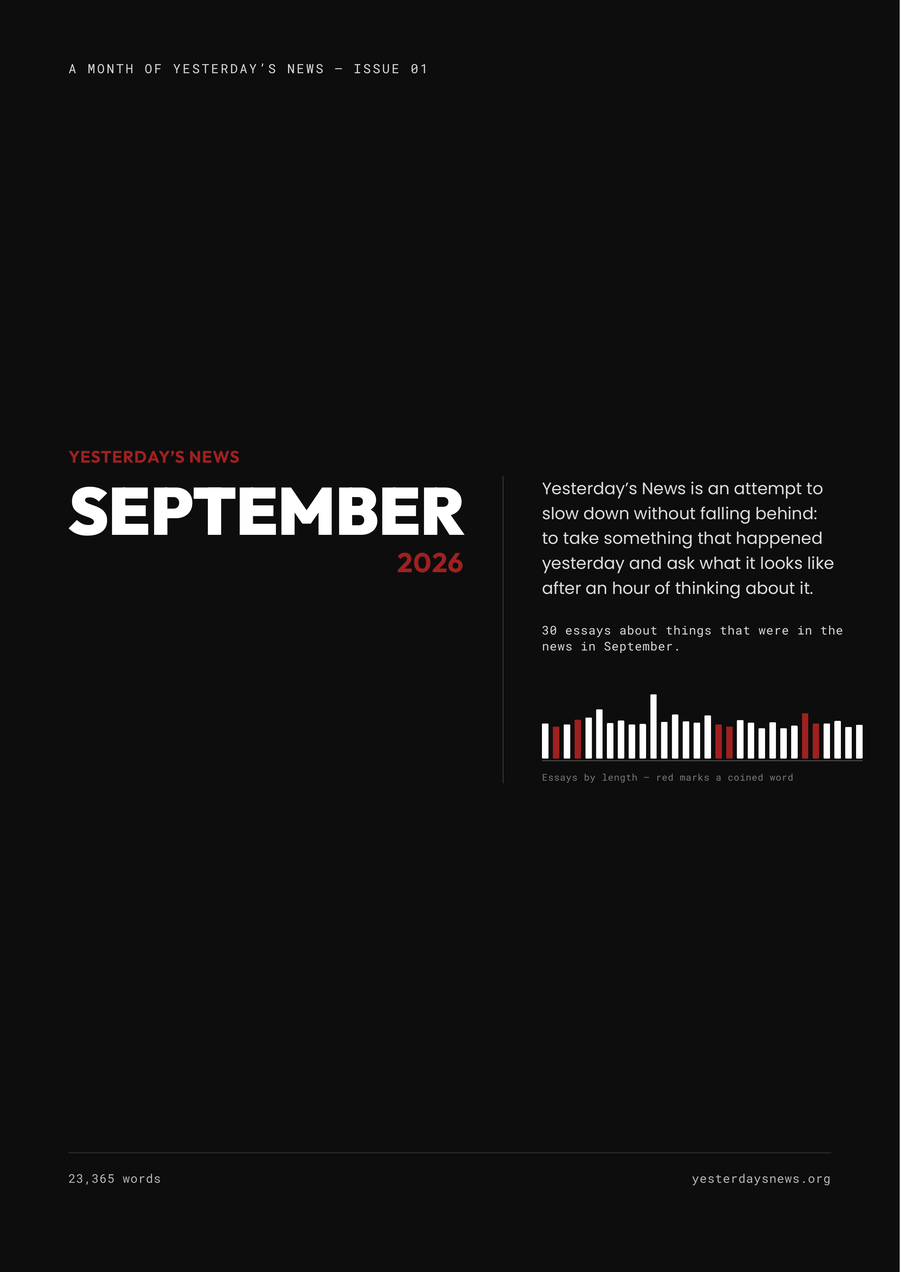
September 2026
Issue 01 – 30 essays, 23,365 words. One day at a time, then compressed: the month’s themes, the words it invented, and twelve lines worth keeping.
Every essay below already has its own page on this site – this is the view from above: the calendar, the patterns across days, and the lines still worth rereading a month later. Each piece links straight through to the day it belongs to. The whole issue is also laid out as a single PDF, built to read start to finish or keep on a shelf.
September, one day at a time
Thirty days, thirty essays – no skipped days, no filler. The ten in red are where a line is worth reading twice.
01
Anomaly or Signal
02
The Living Compiler
03
The Polygons of Saturn
04
Temporary Aligned Zones
05
A New Map for the Same World
06
The Horde Wall
07
A Different Kind of Thing
08
No Lying Required
09
Ten Thousand Explorers
10
The Things That Don’t Fit
11
Nothing But the Truth
12
Between a Rock and a Hard Place
13
The Centre Cannot Hold
14
Fuzzy Borders
15
Risk Appetite
16
The Language Virus
17
The Parthenon Principle
18
Guyana’s Accergy
19
An Experiment to Live Inside
20
The Wrong History
21
The Actor Among Other Agents
22
Is Intervention the New Conservation?
23
Occupational Hazard
24
The Rules of the Skeleton
25
The Wrong Apocalypse
26
The Age of Projucts
27
The Life of the Gift
28
The Shape of Understanding
29
Form Follows Constraint
30
What Makes a Mind Continuous?
September compressed
The shortcut to knowing what this month was really about.
Frame 01
When does something count as real?
Several essays circled the same hinge: evidence exists before anyone agrees what kind of thing it is evidence of. A bad tennis match, a new wave circling Saturn’s pole, a biological signature on a distant exoplanet, a vinyl record with no cutting lathe in its history – each one asks how long, or how much agreement, it takes before a trace becomes a fact.
Frame 02
Boundaries that hold only as long as someone needs them to
Hugging Face stays open because Nvidia needs it open. Tetris’s falling blocks get repurposed into a border-wall game because nobody examines the procedure underneath. Canada edges toward Europe in some respects while staying American in others. A flock of birds shares airspace with a drone that has a licence and a route, and the bird does not. The month kept finding boundaries that are really just temporary alignments of interest, dressed up as fixed lines.
Frame 03
Memory is a decision, not a record
A war criminal is buried with a rifle salute; the verdict against him does not change, but it stops being the organising memory. A dog becomes a diplomatic debt, then just a dog again, and the debt never fully disappears. An anaesthetised brain does not switch off – it just stops being able to stay connected to its own recent past. Three different scales, the same mechanism: what persists is decided by what keeps getting reinforced, not by what happened.
Frame 04
The AI debate is getting fact-checked harder than AI itself
Ten thousand agents found a proof no one of them could find alone; a swarm of agents found holes in the NSA’s software, in a test, with the safety switches deliberately off – which is not the sentence that ended up getting repeated. The month’s most useful AI essay wasn’t about what AI can do, but about the gap between observed, plausible and inevitable, and about why repetition can make a claim feel truer without a single new fact arriving.
Frame 05
Design without a designer
A wave finds its own looping path inside a constrained cavity. Cartilage changes because a regulatory switch changed, not because evolution invented a new part. Buffett’s sixty-year experiment worked because it specified a behaviour, not a target. None of these things were designed in the usual sense, where someone plans the outcome. They were set up: build the constraint, then watch what the constraint produces.
Frame 06
Doing something to a thing is often how you find out what it is
Ryugu’s asteroid dust had to be destroyed to learn when it was born. A map was never really a picture of the world, but a way of doing something to it – steering a ship, comparing continents, now steering opinion at the UN. An actor’s performance of Mark Zuckerberg changed how his own film set behaved before a single frame was shot. However good the instruments get, this month kept finding the same limit: some things you don’t get to just observe. You have to act on them to find out what they are.
Words the month invented
Temporary aligned zone
A space that stays open not because power left it alone, but because power’s own interests currently need it open.
Day 4 – Temporary Aligned Zones
Latent architecture
A site valued not for what’s already built on it, but for what it could be instructed to become.
Day 2 – The Living Compiler
The Parthenon Principle
What happens when an explanation of a thing becomes a rule for designing the next thing – even if the explanation turns out to be wrong.
Day 17 – The Parthenon Principle
Accergy
The portion of a system’s new possibilities its institutions can actually reach, as opposed to the portion that is merely, theoretically, now possible.
Day 18 – Guyana’s Accergy
Projuct
A product shipped deliberately unfinished, with a gap left open for its users to design the rest.
Day 26 – The Age of Projucts
p(doom), p(amp), p(subcog), p(mood)
Four different AI risks routinely collapsed into one headline number: extinction, amplified harm, outsourced cognition, and the mood of the information we swim in.
Day 25 – The Wrong Apocalypse
The funniest and the strangest
- The White House launched a vintage-styled arcade whose flagship game turns Tetris into a border-wall simulator – and the Tetris Company had to clarify, on X, that it has nothing to do with it. The same arcade’s Snake clone, »Rio Run«, has the player »deport« migrants along the Rio Grande. (Day 6)
- Confronted with existential AI risk, Nvidia’s Jensen Huang reportedly turned up the collar of his leather jacket and put the odds at zero per cent by 2030. (Day 25)
- Warren Buffett’s entire succession plan, in one line: »Think of Howard as a policy the shareholders own and hope never to claim against.« (Day 19)
- Magnus confesses twice this month: to being predictably terrible at tennis after a year off, and to an architecture-school tutor once asking »why are you not challenging the ground datum« when he meant »why are your floors flat«. (Day 1, Day 16)
Twelve lines worth keeping
»Djokovic is caught between anomaly and signal. He doesn’t yet know which.«
»A temporary aligned zone doesn’t need power to disappear. It only needs power to stop needing it.«
»We don’t need fewer maps. We need better reasons for choosing between them.«
»Srebrenica is still true. The verdict still stands. The Butcher is buried. No lying required.«
»The centre is not a place between left and right. It’s a space a political system has to keep making.«
»When every alarming fact is true, the difficult question is no longer whether we’re being told the truth.«
»The energy was never the hard part. The accergy is.«
»A good fake doesn’t just imitate a thing. It reveals what we were using to decide that the thing was real.«
»The product is no longer the answer. It’s the question.«
»An exchange ends when the account is settled. A gift ends when no one remembers there ever was one.«
»Harry Beck’s map has been wrong about London for nearly a hundred years. It never collapsed, because it never once pretended to be right.«
»Perhaps we’ll wish we’d spent a little less time on p(doom), and a little more on p(mood).«