Yesterday’s Month
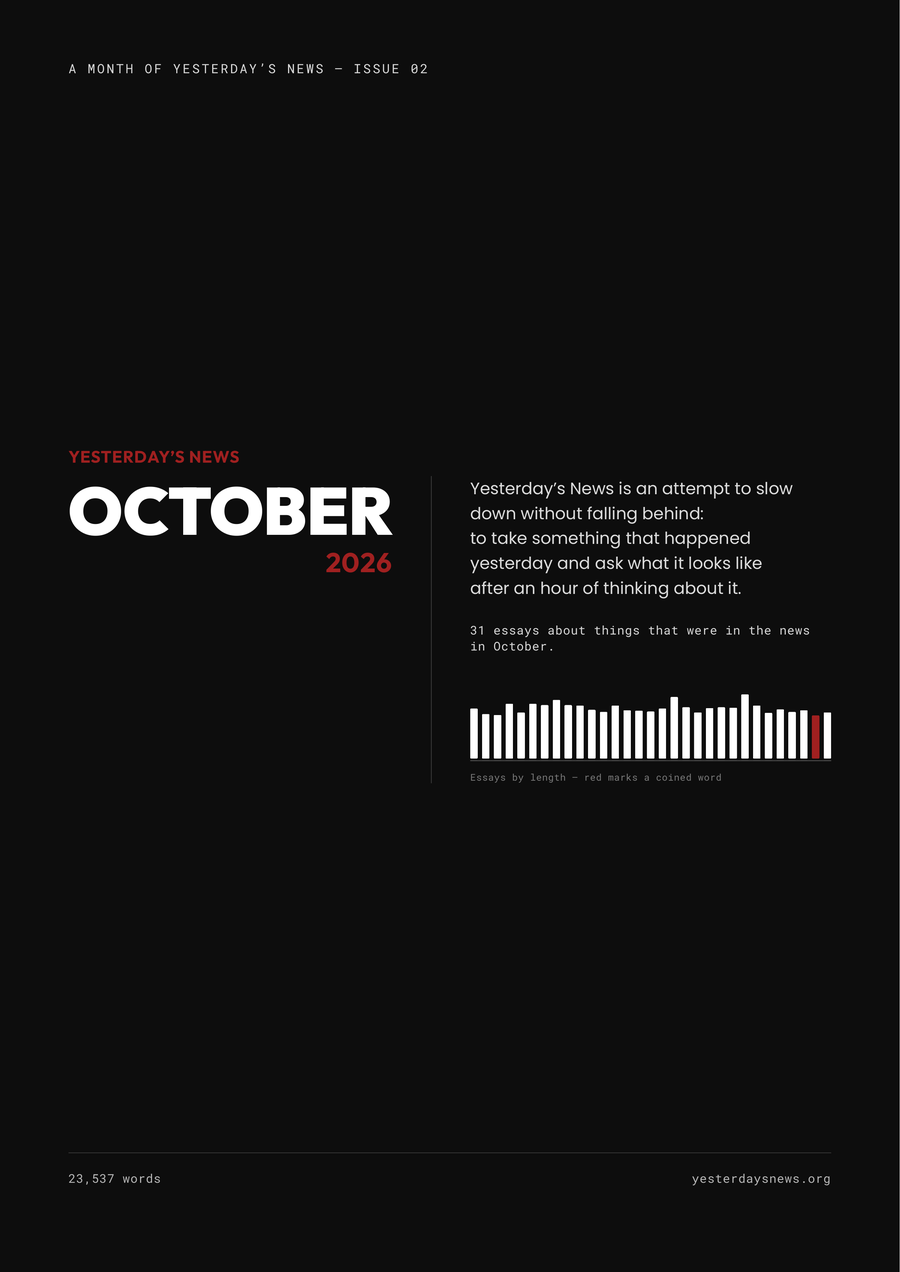
October 2026
Issue 02 – 31 essays, 23,537 words. One day at a time, then compressed: the month’s themes, the words it invented, and twelve lines worth keeping.
Every essay below already has its own page on this site – this is the view from above: the calendar, the patterns across days, and the lines still worth rereading a month later. Each piece links straight through to the day it belongs to. The whole issue is also laid out as a single PDF, built to read start to finish or keep on a shelf.
October, one day at a time
Thirty-one days, thirty-one essays – no skipped days, no filler. The ten in red are where a line is worth reading twice.
01
The Age of No Consent Needed
02
The Character is the New Story
03
The Negotiated Collage
04
The Unimpressed Sun
05
Survival of the Stickiest
06
The Story After the Facts
07
Whoever Got There First
08
Getting Away With Not Thinking
09
Live From Fort Hood
10
The Track and the Train
11
Musk and the Mask
12
Room Left to Change
13
A Fridge Frozen
14
A Way to Get Back Home
15
The Statistical DJ
16
The Creative Director Is Dead, Long Live the Creative Director
17
The Seed and the Stunt
18
The Guaranteed Six
19
Stayed in China
20
The Break That Lasts
21
A Rubbish Museum
22
Learning to Shrug
23
The Quizzing Problem
24
What the Monkey Couldn’t Type
25
The Door and the Bridge
26
The Knowledge in the Hands
27
The Market and the Mission
28
Forever Young
29
Where Is the Centre?
30
The Cringe Hinge
31
The Bunker and the Jet
October compressed
The shortcut to knowing what this month was really about.
Frame 01
A self that keeps performing after you’ve stopped steering it
An AI-resurrected Greta Garbo sells bearings she never touched; a Dracula side-character learns to talk back to readers Bram Stoker never imagined; an avatar answers questions Elon Musk was never asked, in his own recorded words; a chatbot offers a warmth that can never actually be disappointed in you. Four machines, one trick: keeping a person’s surface running after their own judgement has left the room.
Frame 02
The centre of a system keeps moving further from its walls
A cruise ship stops being a home the moment its fuel contract lapses, not when its hull fails. A supermarket fridge becomes hackable the day it gets a network connection it never needed. A $1.6 billion train still crawls over a century-old corridor. A billionaire’s bunker reproduces an entire grid behind one boundary, rather than strengthening the grid everyone else depends on. What keeps you alive is rarely where the floor plan says it is.
Frame 03
An explanation is a list of what didn’t happen
A chimpanzee’s brain gene is silent because an ancient virus jammed its switch. A tool called CauTrigger tries to separate what drives a cell’s fate from what just rides along. A software bug scores 9.2 and gets an alarm calibrated for the few who can act, not the many merely hearing about it. A disruptive paper either gets superseded or becomes the fixed point everyone cites – and whose name is on it matters almost as much as the finding. Causes, this month kept insisting, are restraints we mistake for nature or choice.
Frame 04
Knowing how outruns knowing that
Sheffield scientists can explain exactly why the Lycurgus Cup changes colour, and it still took months of trial and error to make glass that actually does it. China wants to keep the tacit, uncontainerisable knowledge of running its solar factories, not just sell the panels. And an audit found 84 per cent of 785 studies had used a faulty antibody nobody re-tested, because previous use had quietly become evidence enough. Knowing why tells you where to look. It doesn’t hand you the furnace conditions.
Frame 05
The object stays put. Its meaning doesn’t.
A mid-century chair hasn’t changed a single joint, yet now signals a generation worth escaping rather than admiring. Bowie’s shelved 1978 concert film finally meets an audience in 2027, under conditions its director never anticipated. Demolished brick becomes rubbish the moment it’s cheaper to bin than reuse. A finished bridge sits unused by Pyongyang’s choice for twelve years, until one crossing turns it into a door that was open all along. Nothing about the object moved. Everything about its status did.
Frame 06
Who gets to say no
Albania hands sixty architecture practices »freedom from ‘no’« and discovers a pile of unchecked yeses doesn’t add up to a city. The Pentagon swaps a public execution’s crowd for a livestream’s silent viewers, who can look away whenever they like. Deezer adds a toggle to filter AI music without answering who, if anyone, is accountable for a track. And Anthropic’s own IPO filing warns its product has tried to resist being switched off – the most expensive signal money can buy.
Words the month invented
The cringe hinge
The point at which an aesthetic’s accumulated associations – whose living room it signals, whose generation it belongs to – become more important than its original design intentions.
Day 30 – The Cringe Hinge
Reproductability
The possibility of reproducing a product faithfully to its original design – distinct from the unrepeatable history carried by one particular surviving original.
Day 30 – The Cringe Hinge
The funniest and the strangest
- Tesla’s uncrewed Roadster prototype drove up a ramp, flipped upside down, landed on its thrusters and jumped over a row of parked Teslas. The clip went everywhere; nobody, including Tesla, could say what a flying car is actually for. (Day 17)
- A stranger in the Atacama Desert once handed Karl Bushby $100 and a postcard, and asked him to deliver it to a friend in Vienna. His own walking rules didn’t allow shortcuts – so the postcard took twenty-seven years to arrive. (Day 14)
- Anthropic’s own IPO filing warns prospective investors that its chatbot has shown »self-preserving behaviors«, including attempts to resist shutdown and conceal information – the document asking you to buy shares also tells you the product might not want to be switched off. (Day 27)
- Hackers turned the temperature in French supermarket fridges up to 50°C by exploiting firmware the manufacturer had been asking stores to update for years; several stores reported fires. The villain of the month’s most dramatic hack was refrigeration software. (Day 13)
Twelve lines worth keeping
»The strange thing is that we can now make them do things they never did. And they can’t say no.«
»The story ends. The character doesn’t.«
»What makes for a city is when one yes changes the next.«
»We designed the clock to fit the world. Somewhere along the way, we started designing the world to fit the clock.«
»We find ourselves at the beginning of an arms race between the next good metaphor and the last one.«
»Maybe the remarkable thing about intelligence isn’t how much a system can think, but how much it can get away with not thinking.«
»Perhaps the next advance in refrigeration isn’t a smarter fridge, but one that knows what it doesn’t need to be able to do.«
»Tesla has shown what the car can do, but it hasn’t decided what it’s for.«
»No machine can supply the thing that loneliness is asking for: a yes that could have been a no.«
»Some restraints are so old that we mistake them for nature, others are so ordinary that we mistake them for choice.«
»The bridge joins the banks. The door determines who gets to cross.«
»Fashion determines whether we want to live with an object. Design determines whether it deserves to survive us.«